To quickly remind you, we’ll be having a Mini Seminar this Friday (17th June); Dr. Akosua Ampofo will be speaking on Gender & Development. Professor Ampofo is the Director of the Institute of African Studies at the University of Ghana. The seminar will take place in our usual classroom (3D) but will start at 3.30pm instead of 3.
Another quick thing – I’ve recently created a YLMP fan page on Facebook and would like to close our group page. With a minimum of 25 likes (which we should be able to get easily), I will be able to secure the ‘facebook.com/ylmp’ URL (which would be fantastic!!) The transition has been pretty slow going so far though; I’d really appreciate it if you could help out by giving the page a like at www.facebook.com/pages/Databank-Foundation-Young-Leaders-Mentorship-Programme/217964914881526. Please encourage your mentees, friends, family and colleagues to do the same!

Friday, June 17, 2011


Thursday, June 16, 2011
We've been reading...
**Click on titles to read the whole article
Use cellphones to share Africa resource wealth
Reuters -- Mobile phone banking should be used to direct some of Africa's oil and mineral wealth straight to the population, reducing the role of corrupt governments and tackling poverty, according to a senior World Bank official. The continent is riding a commodities boom driven by high minerals and oil prices and analysts expect the trend to continue. But graft and bad governance means revenues have been squandered and resource-rich countries have consistently failed to deliver basic services to their people. "Imagine your country finds a valuable commodity and before it goes into the national budget, and people fear it will be wasted, it could be sent directly to people," said Marcelo Giugale, the World Bank's head of Poverty Reduction and Economic Management in Africa...
Tapping the Wealth of African SMEs: Standard Bank’s Example
AfriBiz -- Small and medium enterprises (SMEs) in Africa have been largely neglected in the past. Most industry analysts and experts agree that there is strong evidence of funding targeted at large corporations, and the micro finance industry has grown rapidly in the past few years; however, financing to the SME sector shows a yawning gap. In the South African economy for example, an economy more structured and better regulated than most African economies, SMEs are said to contribute to 40% of GDP and 40% of employment opportunities – providing the greatest contribution among types of businesses. However, even with this impressive potential, funding to SMEs in South Africa, though well above the African average, is still well behind the trends in other economies of the world...
The Responsibility of Intellectuals
Noam Chomsky -- Twenty years ago, Dwight Macdonald published a series of articles in Politics on the responsibility of peoples and, specifically, the responsibility of intellectuals. I read them as an undergraduate, in the years just after the war, and had occasion to read them again a few months ago. They seem to me to have lost none of their power or persuasiveness. Macdonald is concerned with the question of war guilt. He asks the question: To what extent were the German or Japanese people responsible for the atrocities committed by their governments? And, quite properly, he turns the question back to us: To what extent are the British or American people responsible for the vicious terror bombings of civilians, perfected as a technique of warfare by the Western democracies and reaching their culmination in Hiroshima and Nagasaki, surely among the most unspeakable crimes in history...
The future of funding: Development aid as an investment
Huffington Post -- There is an intriguing dynamic developing in our nation's capital among the three major influences that could end up changing the future of American aid to developing countries. One is Congresswoman Kay Granger from Ft. Worth, TX. Another is Rajiv Shah, Administrator of the US Agency for International Development (USAID). And then there is the Chicago Council on Global Affairs that has assumed the role of arbiter of the quality of the U.S. government's leadership in global agricultural development. Each of them has the power to exert enormous influence over the gristmill through which government funding is pulverized into short and long term support. Congresswoman Granger set the table recently at a luncheon when she praised Bill Gates and his foundation as a model for serving the world's poorest. "Foreign aid must be viewed as an investment, not an expense," she said. "Where money is wasted, it should be stopped. Where funding is ineffective, it should be redirected...
Use cellphones to share Africa resource wealth
Reuters -- Mobile phone banking should be used to direct some of Africa's oil and mineral wealth straight to the population, reducing the role of corrupt governments and tackling poverty, according to a senior World Bank official. The continent is riding a commodities boom driven by high minerals and oil prices and analysts expect the trend to continue. But graft and bad governance means revenues have been squandered and resource-rich countries have consistently failed to deliver basic services to their people. "Imagine your country finds a valuable commodity and before it goes into the national budget, and people fear it will be wasted, it could be sent directly to people," said Marcelo Giugale, the World Bank's head of Poverty Reduction and Economic Management in Africa...
Tapping the Wealth of African SMEs: Standard Bank’s Example
AfriBiz -- Small and medium enterprises (SMEs) in Africa have been largely neglected in the past. Most industry analysts and experts agree that there is strong evidence of funding targeted at large corporations, and the micro finance industry has grown rapidly in the past few years; however, financing to the SME sector shows a yawning gap. In the South African economy for example, an economy more structured and better regulated than most African economies, SMEs are said to contribute to 40% of GDP and 40% of employment opportunities – providing the greatest contribution among types of businesses. However, even with this impressive potential, funding to SMEs in South Africa, though well above the African average, is still well behind the trends in other economies of the world...
The Responsibility of Intellectuals
Noam Chomsky -- Twenty years ago, Dwight Macdonald published a series of articles in Politics on the responsibility of peoples and, specifically, the responsibility of intellectuals. I read them as an undergraduate, in the years just after the war, and had occasion to read them again a few months ago. They seem to me to have lost none of their power or persuasiveness. Macdonald is concerned with the question of war guilt. He asks the question: To what extent were the German or Japanese people responsible for the atrocities committed by their governments? And, quite properly, he turns the question back to us: To what extent are the British or American people responsible for the vicious terror bombings of civilians, perfected as a technique of warfare by the Western democracies and reaching their culmination in Hiroshima and Nagasaki, surely among the most unspeakable crimes in history...
The future of funding: Development aid as an investment
Huffington Post -- There is an intriguing dynamic developing in our nation's capital among the three major influences that could end up changing the future of American aid to developing countries. One is Congresswoman Kay Granger from Ft. Worth, TX. Another is Rajiv Shah, Administrator of the US Agency for International Development (USAID). And then there is the Chicago Council on Global Affairs that has assumed the role of arbiter of the quality of the U.S. government's leadership in global agricultural development. Each of them has the power to exert enormous influence over the gristmill through which government funding is pulverized into short and long term support. Congresswoman Granger set the table recently at a luncheon when she praised Bill Gates and his foundation as a model for serving the world's poorest. "Foreign aid must be viewed as an investment, not an expense," she said. "Where money is wasted, it should be stopped. Where funding is ineffective, it should be redirected...
Wednesday, June 15, 2011
Doodle4Google in Ghana
I'm reblogging this post from the Google Africa blog. It was written by Estelle Akofio-Sowah, the head of Google Ghana and Africa Leadership Initiative fellow. I'm encouraged by the work Google does to encourage creativity among the youth and by the fact that they go the extra mile to showcase it. Most of all, I'm glad that the Ghanaian public is getting behind their youth and supporting them in projects such as these.
At Google we work hard to bring the Internet closer to our users. We also love to encourage and celebrate the creativity of young people. Doodle4Google is a great way to achieve this. This year, over 700 submissions from over 50 schools were an amazing display of the imagination of young people in Ghana about what Ghana represents to them.
We hope that today (Wednesday 15th June), when we feature the winning Doodle from the 9 - 11 year old category, and tomorrow (Thursday 16th June), featuring the winning Doodle from the 12 - 14 year old category on google.com.gh, Ghanaians will enjoy these amazing doodles that creatively capture what is special and unique about Ghana in the eyes of our youth.
On June 11th, Marvels Mini Golf course in Dzorwulu, Accra was the venue for hosting the 80 top-performing doodlers in this years Doodle4Google “My Ghana” competition. The kids arrived with a great sense of excitement and anticipation in advance of the announcement of this year’s winners. They had loads of fun with new friends, learning origami and mini golf skills with the team from the Kokrobitey Institute. Our special guest Kwaku Sintim Misa (KSM) shared inspiring words on the importance of education and dreaming big, whilst a performance from “2 Puff”, got everyone dancing with their fun dance moves.

The high quality of all the doodles submitted made choosing our winners no easy task! With a great big African drum roll, we unveiled the winning Doodles by Nil Carreras Del Peso from the French School and Nana Abena Asabea Ametepe from Golden Age School.
Nil, aged 11, named his doodle “Traditional Ghana”, a blend of Ghana’s rich culture, from our Gye Nyame symbol, coconut trees, beads, village huts and flag. Nana who is 12, named her doodle “Home Sweet Home”, a popular saying in Ghana used on shops, buses, and on what used to be a popular means of public transportation, our “tro-tros”. Her doodle is an amazing watercolour painting capturing a traditional village scene with two women carrying water pots on their heads.
The winners also received a Kindle loaded with great books including “Voice in the Forest” by Efua T. Sutherland and “The Days” by Ama Ata-Aidoo and a laptop respectively. In addition, the schools of both winners received a USD 2,000 technology grant.
For all of us at Google, this year’s competition has been an incredible insight into the creative minds of young people. We hope you enjoy their doodles as much as we have! Congratulations again to Nil and Nana Abena!
At Google we work hard to bring the Internet closer to our users. We also love to encourage and celebrate the creativity of young people. Doodle4Google is a great way to achieve this. This year, over 700 submissions from over 50 schools were an amazing display of the imagination of young people in Ghana about what Ghana represents to them.
We hope that today (Wednesday 15th June), when we feature the winning Doodle from the 9 - 11 year old category, and tomorrow (Thursday 16th June), featuring the winning Doodle from the 12 - 14 year old category on google.com.gh, Ghanaians will enjoy these amazing doodles that creatively capture what is special and unique about Ghana in the eyes of our youth.
On June 11th, Marvels Mini Golf course in Dzorwulu, Accra was the venue for hosting the 80 top-performing doodlers in this years Doodle4Google “My Ghana” competition. The kids arrived with a great sense of excitement and anticipation in advance of the announcement of this year’s winners. They had loads of fun with new friends, learning origami and mini golf skills with the team from the Kokrobitey Institute. Our special guest Kwaku Sintim Misa (KSM) shared inspiring words on the importance of education and dreaming big, whilst a performance from “2 Puff”, got everyone dancing with their fun dance moves.

The high quality of all the doodles submitted made choosing our winners no easy task! With a great big African drum roll, we unveiled the winning Doodles by Nil Carreras Del Peso from the French School and Nana Abena Asabea Ametepe from Golden Age School.
Nil, aged 11, named his doodle “Traditional Ghana”, a blend of Ghana’s rich culture, from our Gye Nyame symbol, coconut trees, beads, village huts and flag. Nana who is 12, named her doodle “Home Sweet Home”, a popular saying in Ghana used on shops, buses, and on what used to be a popular means of public transportation, our “tro-tros”. Her doodle is an amazing watercolour painting capturing a traditional village scene with two women carrying water pots on their heads.
The winners also received a Kindle loaded with great books including “Voice in the Forest” by Efua T. Sutherland and “The Days” by Ama Ata-Aidoo and a laptop respectively. In addition, the schools of both winners received a USD 2,000 technology grant.
For all of us at Google, this year’s competition has been an incredible insight into the creative minds of young people. We hope you enjoy their doodles as much as we have! Congratulations again to Nil and Nana Abena!
Tuesday, June 14, 2011
U.S. colleges accused of African "land grabs"
There have been many news articles in the last few weeks about 'land grabs' from affluent and organisations in the West. (Here's one I found particularly appalling in the Economist.) Here, CBS News exposes some US colleges who have allegedly joined the bandwagon:
The questionable, unchecked, speculative practices of large financial institutions that sent the world into a near-calamitous economic recession recently are being repeated in Africa through land-grabbing deals, The Oakland Institute, a California-based think tank, said in a recent report.
Hedge funds are partaking in "largely unregulated land purchases" throughout the continent that essentially amount to "the conversion of African small farms and forests into a natural-asset-based, high-return investment strategy" and are often nothing more than "land grabs," the report states.
Additionally, several American universities, including Harvard, Vanderbilt, Spellman, and Iowa universities, are also taking part in or providing funds for the practice that "is resulting in the displacement of small farmers, environmental devastation, water loss and further political instability such as the food riots that preceded the Tunisian and Egyptian revolutions," the reports states.
While the report does not claim the deals break any laws per se, it does strongly insinuate the local population does not reap anything near the promised benefits, whereas the mostly foreign investors in some cases can expect to get up to 25 percent returns.
Mobile templates have gone live!
Great news for everyone who checks the blog on the go - mobile templates have gone live!! I'm a bit late with the news actually, the update came on the 8th of June. Unfortunately (and perhaps predictably) though, Symbian seems to have been bypassed. You can still access the mobile site: http://ylmp.blogspot.com/?m=1.
I apologise for the inconvenience to all fellow Nokia heads, I'll let you know as soon as anything changes.
I apologise for the inconvenience to all fellow Nokia heads, I'll let you know as soon as anything changes.
Thursday, June 9, 2011
Advances in mobile health technology
This is part of a post by Meghan O'Hearn on the ONE blog. Read it in full here.
According to a new report from the UN Foundation and mHealth Alliance, there are now more than five billion wireless subscribers in the world. More than 70 percent of them reside in low- and middle- income countries. From using mobile phones to coordinating emergency health relief efforts to reminding patients to take their medicine, mHealth offers some serious potential for creative health care improvements in all corners of the world.
The report, titled New Horizons for Health through Mobile Technologies, said 83 percent of the 112 participating member states reported the presence of at least one mHealth initiative in their country. Of these, three-quarters reported four or more types of mHealth initiatives including health call centers, emergency toll-free telephone services, and mobile telemedicine.
These mHealth programs have helped some achieve impressive goals on the ground. The Ghana Medical Association, for example, launched the Mobile Doctors Network in Africa in 2008 to wirelessly connect an estimated 2,000 physicians in Ghana with free mobile-to-mobile voice and text services. The project has been tremendously successful in helping serve Ghana’s 24 million people as well as facilitate prompt emergency response communication.
And in 2007, the Bangladesh Ministry of Health began broadcasting SMS text messages to the country’s estimated 55 million mobile telephone numbers to increase awareness about health campaigns, particularly childhood vaccination initiatives. This project’s success has prompted several other health-related SMS services, including a pregnancy advice system for mothers.
Although lack of infrastructure, operating costs and knowledge about mHealth are significant barriers to implementation, particularly in rural Africa, progress is real. Only 10 percent of the African population had mobile phone coverage in 1999. By 2008, mobile phone coverage climbed to 60 percent of the population. By 2012, most villages in Africa will have coverage, with only Guinea Bissau, Ethiopia, Mali and Somalia staggering behind. Given unprecedented growth rates, the sky’s the limit with mobile technologies in the global health care arena.
According to a new report from the UN Foundation and mHealth Alliance, there are now more than five billion wireless subscribers in the world. More than 70 percent of them reside in low- and middle- income countries. From using mobile phones to coordinating emergency health relief efforts to reminding patients to take their medicine, mHealth offers some serious potential for creative health care improvements in all corners of the world.
The report, titled New Horizons for Health through Mobile Technologies, said 83 percent of the 112 participating member states reported the presence of at least one mHealth initiative in their country. Of these, three-quarters reported four or more types of mHealth initiatives including health call centers, emergency toll-free telephone services, and mobile telemedicine.
These mHealth programs have helped some achieve impressive goals on the ground. The Ghana Medical Association, for example, launched the Mobile Doctors Network in Africa in 2008 to wirelessly connect an estimated 2,000 physicians in Ghana with free mobile-to-mobile voice and text services. The project has been tremendously successful in helping serve Ghana’s 24 million people as well as facilitate prompt emergency response communication.
And in 2007, the Bangladesh Ministry of Health began broadcasting SMS text messages to the country’s estimated 55 million mobile telephone numbers to increase awareness about health campaigns, particularly childhood vaccination initiatives. This project’s success has prompted several other health-related SMS services, including a pregnancy advice system for mothers.
Although lack of infrastructure, operating costs and knowledge about mHealth are significant barriers to implementation, particularly in rural Africa, progress is real. Only 10 percent of the African population had mobile phone coverage in 1999. By 2008, mobile phone coverage climbed to 60 percent of the population. By 2012, most villages in Africa will have coverage, with only Guinea Bissau, Ethiopia, Mali and Somalia staggering behind. Given unprecedented growth rates, the sky’s the limit with mobile technologies in the global health care arena.
Thursday, June 2, 2011
6 Tips to set effective goals
In the video below, Jesse Stoner gives six steps to set effective goals that will get you where you want to go. She is a business consultant who runs a blog particularly for those who want to make a contribution as a leader.
You can find a text version of this presentation on her blog.
You can find a text version of this presentation on her blog.
We need more good news stories on development
Here's an article from the Guardian by Jonathan Glennie.
Earlier this week I went to one of the Living Proof roadshows organised by ONE, the campaign group set up by Bono and Bob Geldof. Like the previous one I attended, at which Bill and Melinda Gates spoke, the message was simple: things are getting better, the development project is working, and aid is a key element in that picture.
The objective of the meetings is to persuade a sceptical public to support more aid. One of the centrepieces of the evening was a video in which people on the street were asked how much aid they thought the UK gave and how much difference they thought it was making. Predictably, the public tends to think the UK gives a lot more than it does, and that much is wasted.
Public awareness is an admirable and necessary goal, with the caveat that we have to be realistic about our ambitions in development education. Most people don't really have time to show much interest in the goings on of foreign countries, let alone delve deeply into the statistics. So we needn't beat ourselves up too badly about the fact that few people seem to care or know much about this sector – it is just like most other sectors in that regard, with some people very committed but most fairly ignorant.
Earlier this week I went to one of the Living Proof roadshows organised by ONE, the campaign group set up by Bono and Bob Geldof. Like the previous one I attended, at which Bill and Melinda Gates spoke, the message was simple: things are getting better, the development project is working, and aid is a key element in that picture.
The objective of the meetings is to persuade a sceptical public to support more aid. One of the centrepieces of the evening was a video in which people on the street were asked how much aid they thought the UK gave and how much difference they thought it was making. Predictably, the public tends to think the UK gives a lot more than it does, and that much is wasted.
Public awareness is an admirable and necessary goal, with the caveat that we have to be realistic about our ambitions in development education. Most people don't really have time to show much interest in the goings on of foreign countries, let alone delve deeply into the statistics. So we needn't beat ourselves up too badly about the fact that few people seem to care or know much about this sector – it is just like most other sectors in that regard, with some people very committed but most fairly ignorant.
Wednesday, June 1, 2011
Coming of the Drums: Behind the scenes
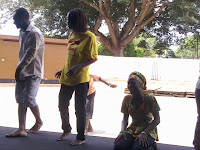
While we eagerly wait for the DVD of the Coming of the Drums, I thought I'd post a few behind the scenes pictures. They were taking at various stages during rehearsals (click on each photo to enlarge; more after the jump). Enjoy!
Also, click here and here to check out more photos on our new Facebook page! And don't forget to like us!




Also, click here and here to check out more photos on our new Facebook page! And don't forget to like us!


Subscribe to:
Posts (Atom)